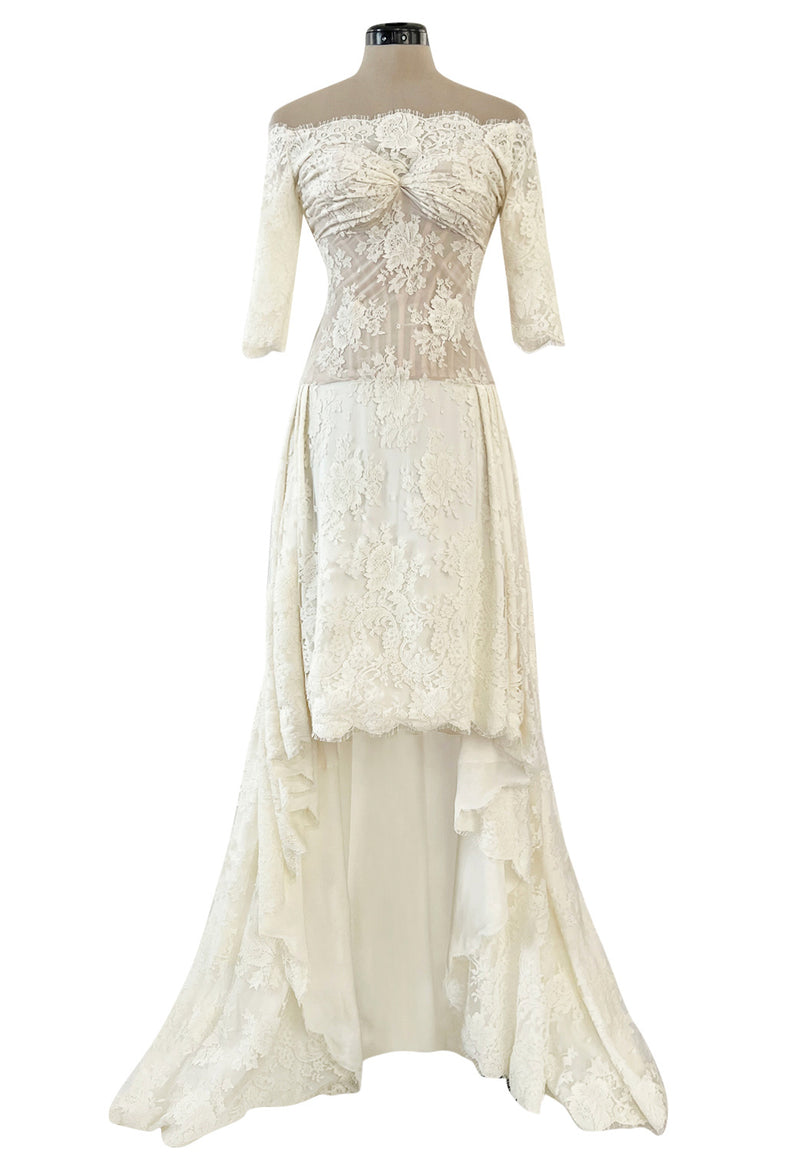
designer wedding dresses alexander mcqueen Incredible 2012 Alexander McQueen Ivory Lace Corseted Wedding Dress w –  Shrimpton Couture
SKU: 59196676763
designer wedding dresses alexander mcqueen

designer wedding dresses alexander mcqueen Incredible 2012 Alexander McQueen Ivory Lace Corseted Wedding Dress w – Shrimpton Couture

Sale price$22.98 Regular price$25.53
Save 10%
Size: 4

Pay in installments of $6.38 with ShopPay, AfterPay and Klarna

Shipping Estimate
USA
  • USA
  • CAN

Ships within 48 hours · Estimated delivery Jul 1 - Jul 6

Promo Codes Available:

For Your Every Summer RSVP, with Code: SUMMER15

Description

designer wedding dresses alexander mcqueen Incredible 2012 Alexander McQueen Ivory Lace Corseted Wedding Dress w – Shrimpton CoutureThis dress is instantly recognizable as an Alexander McQueen piece. And it is an incredibly interesting piece when you fully delve into its history. This was a part of the McQueen wedding dress line for the Spring of 2012. By that date the label was under the direction of Sarah Burton. However this dress is a ivory lace version of the dress that Lee designed for the 2007 runway for Look 20. I have seen the twin of this dress for sale at more then

This dress is instantly recognizable as an Alexander McQueen piece. And it is an incredibly interesting piece when you fully delve into its history. This was a part of the McQueen wedding dress line for the Spring of 2012. By that date the label was under the direction of Sarah Burton. However this dress is a ivory lace version of the dress that Lee designed for the 2007 runway for Look 20. I have seen the twin of this dress for sale at more then double my price and mislabeled as being a 2007 original. But it is not. It was produced in 2012 as an updated dress made wedding appropriate and was based on the 2007 dress that I have included here. The 2007 collection was titled "Sarabrande" and the Alexander McQueen website stated this of that collection:The inspiration is Handelís Sarabande of the title is a majestic and elegant dance - the portraits of Goya, the turn of the century exotic and socialite Marchesa Luisa Casati and garden flowers. As always, there is a melancholic undertone: faded flowers are trapped in chiffon and lace, ruffled skirts constructed out of tiers of delicate petals and prints are botanical brightly coloured birds and blooms, scattering swallows and winding stems of leaves. Show pieces include a dress made entirely out of frozen flowers. Tailoring is this time more fluid than it has been and clothing indebted to horsemanship is worn with finely worked, oversized pirate shirts. McQueen's idealisation of the feminine form continues with an exaggerated hour-glass silhouette.' So the dress is an original Alexander McQueen design but one that was executed after his death. The connection to Lee makes it very interesting and the dress is exceptionally beautiful.

The dress is stunning and even though it is meant to be a wedding dress I think that his work transcends any box assigned to it. As stunning a piece it would make for a bride it would also be spectacular for the events surrounding a wedding weekend or as a gala / event piece. The dress is very fitted through the bodice and waist with a fully built in corset whose boning acts as a secondary design element. You can just see it peaking though the lace over the bust and bodice and the curves and complex pattern iff the boning makes for an interesting detail in itself. The breasts are formed and cupped and and the skirt falls to about the knee, depending on your height, at the front. The sleeves are to the elbow and made from a single layer of that stunning lace. It is set to sit off the shoulder and the runway version in black really gives you an idea of fit. On the runway I think they added a hip peplum or tulle under the back and sides to create a more bustle effect. On this one the train falls in a more graceful and soft feeling down the sides and then down the back to slightly train behind you. If you loved the look of the runway it would be easy to have something made to support the fabric underneath and recreate that look. It is an incredible dress and though it does look pretty on my dress form it is no where near as gorgeous as it will be on an actual body. Excellent condition with one minor note below. 

The bodice has a full complexly boned corset and cups and closes with a back hidden set zipper. The lace snaps into place over the top portion of the zipper and just above it. The skirt is fully lined in an ivory silk. This was never worn but there is a small yellowing spot on the back of the lace above the zipper that happened during storage. It is on the underside of the lace that snaps to close so once it is snapped into place the lace above it hides it completely. I have added three photos after the label shots to show this. The first is the mark on the lining, the second to show that it peaks out on the lace just slightly and the third shows it snapped close with the other side over it completely hiding the mark. The corset does have some stretch. Tagged a 42

Sleeves: 12.5"
Bust: approx 17.5" flat across from side seam to side seam with a B-C cup
Waist: 12-14" flat across from side seam to side seam
Seam at the bottom of the corset/top of the hips: 16-17.5"
Natural hips: open
Bodice: 19" from top of natural shoulder to bottom seam of the corset
Skirt: 38" from top of natural shoulder to front hem, 64" to the longest point of the back 

Modern Sizing Equivalent: SML-MED

Item# DD3907

Reference Photos/Video: (1-3) Spring 2007 Alexander McQueen Runway. Look 20 worn by Camila Finn.  /  (4) Cate Blanchett in Black Lace Alexander McQueen at the 2007 Golden Globe Awards

This garment has been professionally cleaned, pressed and is odor free. Thoroughly checked over before shipping, it will be ready to wear upon arrival.


Shipping Notes
  • Free Standard Shipping on $100+ Orders to the USA.
  • Except Preorder products are shipped in 48 hours.
  • Delivery to the USA:
  1. Standard Shipping : 3-10 business days
  • If time is of the essence, please consider selecting expedited delivery for faster service.
Exchange/Return Notes
  • We offer a 30-day return/exchange service after receiving.
  • Final sale items are not eligible for returns or exchanges.
  • To process your return/exchange, please contact us at [email protected]
  • Please click here for more details>>> Return & Exchange Policy
SKU: 59196676763

Discover Niche Categories That Outsell designer wedding dresses alexander mcqueen

Top-Converting Item to Boost Your Average Order

4.6 ★★★★★
Based on 1681 reviews
Sort
Highest Rating
Newest First
Oldest First
Product Reviews
A
Verified Purchase
Anne Mills
Los Angeles, US
★★★★★ 5
Great Reading, Mind Opening
Format: Kindle
This is a terrifically interesting and entertaining book, which presented me with at least two blockbuster ideas that changed the way I think about the past. I'll get to those in a minute, but first a few general points. Charles Mann is a science journalist:who seems to specialize in BIG topics. His 2005 book ("1491", which argues that the pre-Columbian population of the Americas was much larger and more sophisticated than generally assumed), was very well received. I enjoyed it so much, and thought it so valuable a book, that I was very anxious to read "1493". "1493" lived up to my (high) expectations. Mann is remarkable writer, with an extraordinary ability to present very complex facts and ideas in way that's not just accessible to the lay reader, it's fun for the lay reader. This isn't to say that the book isn't carefully researched -- the text is followed by almost 100 pages of footnotes, and throughout he cites and acknowledges the scientists and others from whom he has drawn information. It's just that Mann manages to combine a myriad of facts and hypotheses into a compelling narrative. And he often puts this in very concrete terms, focussing on individual people, commodities or events. It adds up to a fascinating read. It is also a very important one, with implications for the future as well as about the past. Mann's subject in this book is the Columbian Exchange, the sudden movement of plants, microbes, animals and people between the eastern and western hemispheres after Columbus' voyage to the Americas in 1492. A well known effect of this was the eastern hemisphere adoption of western hemisphere foods (tomatoes, potatoes, chocolate, coffee, and on and on). Another effect that's only been recently come to be widely understood is the devastating impact on the pre-Columbian population of the Americas; as many as 80% died in the epidemics that followed the introduction of diseases to which they had no immunity. But the population die-off and the exchange of plant species are not the only effects of the Columbian Exchange. Mann's book explores the myriad ways in which the Exchange -- globablization -- has shaped the world of today. Two things I learned from the book struck me particularly. First, like most Americans of my generation (older) I learned in school that the colonization of the Americas was carried out by white people, who moved into a largely uninhabited continent. "1491" took care of the uninhabited: "1493" takes care of the white. Mann says that from 1500 to 1840, about 3.4 million white Europeans emigrated to the Americas. Over the same period, about 11.7 million captive Africans were sent to the Americas. Except for New England, much of the United States and most of Latin American was far more black than white. (And probably in 1840 still more Indian/Native American than anything else). The racial balance changed as white immigration ramped up and as millions upon millions of blacks died too young, but the picture of early America looks very different to me now. Secondly, Mann discussed at length the 19th century ecological disaster that engulfed China. I had always assumed that the floods that killed so many millions in China had always happened, and were the result of geography. There have indeed always been floods, but their severity and human cost grew logarithmically in the 19th century. New crops led to more food and to rising population growth, and at the same time to more potential cash crops, increasing the pressure on existing land holdings, and leading to vast land clearances. That made the floods far worse when they came, undermining the political structure and compounding China's problems. This was interesting not just a light on the past, but as a warning signal for the future. The review is already too long, so, to sum it up: Great book!! Read it!! Give it to friends and family!!
WAS THIS REVIEW HELPFUL?YesReportShare
Reviewed in the United States on December 6, 2013
S
Verified Purchase
Scott Charles
Dallas, US
★★★★★ 5
LOVED This Read! Blew Me Away
Format: Hardcover
What a fantastic read! Woah. All of the Americas have an extraordinary history. I was mesmerized from beginning to end. If you like knowing your history, you will love this book. Well researched and smartly written. Couldn't put it down. Books like this are why people love to read. If you think you know the Americas, you might be surprised to find that there's more, and be prepared for a bit of a shake up. This book was a real eye opener.
WAS THIS REVIEW HELPFUL?YesReportShare
Reviewed in the United States on November 18, 2025
J
Verified Purchase
James Ferguson
Omaha, US
★★★★★ 4
A Brave New World
Format: Hardcover
It wasn't quite what I expected, but Charles Mann leads the reader on a fascinating journey in the wake of Columbus, focusing mostly on the environmental impact of his "discovery" of the New World. Mann literally spans the globe, as the establishment of Spanish colonies in the Americas would have far reaching consequences. Most interesting to me was how silver came to be the currency of exchange, allow Spain to trade with China, when it established its trading outpost in the modern-day Philippines. Along with silver, came corn, rubber and potatoes which would radically alter the landscape of the world. Mann discusses how corn came to replace rice for many Chinese, and how rubber trees would be transplanted to Indochina, bringing with them unsuspected pests that would wreak havoc on ecosystems. In this sense, the book has similarities with Jared Diamond's but explores different terrain. One of the most interesting chapters was on the highly profitable mining of bird guano and how the British cornered the market in this new fertilizer. Mann describes how the shift to mono-cultures had a tremendous impact on agriculture. At first, these new crops seemed to solve much of the world's food shortages, but then as the Irish famine made all too painfully aware, putting all your "eggs in one basket" can lead to devastating consequences as an unforeseen blight wiped out much of Ireland's food supply. Mann also offers a long study on how slavery evolved and re-shaped the ethnic identity of many countries, particularly those in Central and South America. The miscegenation that took place, with particular focus on Brazil, reshaped cultural patterns and changed the political dynamics in these countries. He offers a number of intriguing case studies, and discussed the long term impact of this human cross-pollination. 1493 is a fascinating study and meditation on life after Columbus. We don't fully realize how rapidly the world changed after this fateful "discovery," and how continents became so interdependent, where before they had been relatively isolated from each other.
WAS THIS REVIEW HELPFUL?YesReportShare
Reviewed in the United States on April 30, 2012
R
Verified Purchase
Russell C.
Natrona Heights, US
★★★★★ 5
Great History book
Format: Paperback
This book was a gift for husband. He loves it. He is a slow reader, but he can’t put book down. New and interesting history facts and stories.
WAS THIS REVIEW HELPFUL?YesReportShare
Reviewed in the United States on February 6, 2026
J
Verified Purchase
John D. Cofield
Grantham, US
★★★★★ 5
Consequence After Consequence
Format: Hardcover
"In Fourteen Hundred Ninety Two, Columbus Sailed The Deep Blue Sea" is a ditty sung by generations of school children. Most of those students learned and believed that Columbus was the only man in Europe who believed the world was round and proved it by sailing three ships west to find the East. In 1493, Charles C. Mann dismisses these legends and goes on to demonstrate that Columbus (or as he refers to him, Colon) and the other Europeans who sailed across the Atlantic in the 1400s and 1500s did far more than just discover a New World, they helped create a planet wide system in which people, plants, animals, and diseases travelled further and were linked in more ways than had ever before been possible. In other words, 1493 was the beginning point of a new age of globalization. This is not a new theory. Alfred W. Crosby developed the term Columbian Exchange back in the 1970s to describe the changes that took place after 1492. Jared Diamond's Guns, Germs, and Steel and Collapse also detailed some of the consequences of the European "discovery" of the Americas. What makes Mann's new book so appealing is his ability to tell an engrossing story that ably explains how one consequence led to another, fundamentally changing society after society and helping to creat our modern world. This is global history at its best, jumping from Ming and Qing China's opulent but troubled societies to the fast growing but still relatively backwards European states to the myriad African and Native American cultures, all of them to be affected by the transfer of peoples, plants, diseases, and ideas. Mann has a keen eye for an appealing and informative anecdote which really details the consequences of seemingly small decisions, such as how the introduction of the sweet potato to China led to deforestation, or how the Little Ice Age was affected by the abandonment of the Native American practice of burning off underbrush in North American forests. Its books like 1493, as well as Mann's earlier and equally excellent 1491, which make studying history so fascinating. I taught Advanced Placement World History to high school students for many years before retiring, and I regularly amused them (at least I hope I did) with many references to Jared Diamond and Alfred Crosby's ideas. With 1493 Charles C. Mann deserves equal recognition by global historians.
WAS THIS REVIEW HELPFUL?YesReportShare
Reviewed in the United States on August 19, 2011

recommand products